Celebrate World Wetlands Day on Feb. 2nd! Wetlands are one of nature’s most fascinating ecosystems. They are distinctive habitats full of hidden treasures ready to be discovered. Wetlands are important enough to have their holiday.
No Flying Monkeys in the Ozarks; We have Barred Owls!
There are certain phone calls I receive that from the first few words of conversation I know what the subject is going to be. For example, the passion vine or passionflower (Passiflora incarnata) native to our region is so different looking that when a caller to the Shoal Creek Nature Center starts to describe a plant as “different looking” or “bizarre” I have a hunch to its identification. The one topic, I like the most, are the dialogs where the caller first identifies themselves as intelligent, not irrational, nor on lots of medication. I’ve even had them say “I’m a normal citizen and have a job!”. I just smile on the other end of the phone, because then they say, “I think I have monkeys in my woods”.
We have eight species of owls in Missouri, and four live here all year long. The other four raptors visit our region during the wintertime. Which makes the cooler seasons the absolute best time for viewing and enjoying owls. Barred owls are likely to be the easiest to observe for the average nature lover; there is no doubt they are the one to hear. Barred owls are just the noisy students in the forested outdoor classroom. They are vocal all the time. When I do education programs for elementary classes, I lead in with Missouri’s owls and their special adaptations. I always end with how owls communicate, and I usually shut the classroom door, so we don’t disturb other classes down the hall. While some of our owl species trill, neigh, and hoot or hooo…barred owls have a repertoire of vocals. Third through fifth grade students like to learn about their communication, especially the main territory calls of a series of hoots that can be placed in a familiar rhythm sounding like “Who Cooks for You, Who Cooks for You ‘all”. However, the barred owls are very social with their partners and during certain times of year with their older offspring (the teenagers); they hoop and holler and carry on for easily 20 minutes or more. It is this ballad disorder when they truly sound like monkeys in the treetops.

These owls stay on territory year-round, so if you have them in your neighborhood or on your farm you are likely enjoying the same birds year after year. Barred owls appreciate mature woodlands, and an ideal habitat is a heavily wooded stream or water environment. To keep their body weight down, owls will cough up a neatly packaged pellet of indigestible fur, scales and bones of their prey. This way the materials don’t have to be in their body for full digestion and makes flight more efficient. Their favorite branch perch will have some pellets on the forest floor below. An easy investigation of the owl pellets will give us evidence of meadow voles, crayfish, snakes, and wood rats. Frogs are part of the diet as well; however, they are easily digested and won’t have remains in the pellet. Naturalists appreciate their role in the environment for where they fit in the food web. Just as many people and school children are fascinated by their adaptations and attractive good looks.
Barred owls have dark eyes (of Teddy Bear quality), and their heads are rounded without feather tuffs. Males and females look similar, but females are slightly larger. Teenagers will have more reddish or brown tones, compared to more gray plumage of older adults. I have to say, I think of them as good neighbors on my farm. Kansas’ Dorothy witnessed flying monkeys in OZ, but we never have to worry about them. And just like lovable neighbors…we all might hear their “music/songs” or conversations …but we smile and appreciate them in our community.
Jeff Cantrell is a local Stream Team biologist and specializes in conservation volunteer engagement. He assists MO Master Naturalist chapters in Joplin, Rolla, and Springfield and is proud to announce their 2024 recognition pin is the Barred Owl. Thank you volunteers for serving our natural heritage!
Field notes by J. Cantrell, photos courtesy of the MO Dept. of Conservation
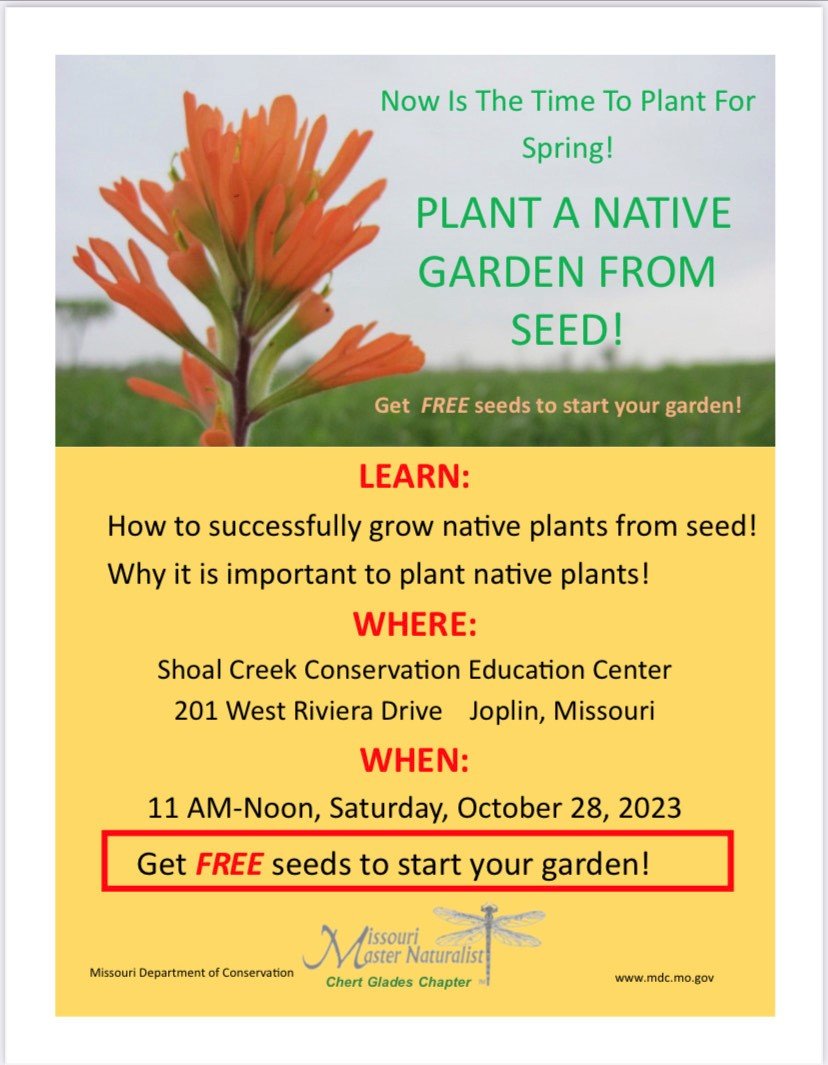
Plant a Native Garden
Monarch Migration - Venturesome Voyage
Look to the sky, all around SW Missouri, and in your own garden for evidence of Monarch Migration!
Creek Caretakers Unite
Chert Glades Chapter hosted a Center Creek litter pickup this week.
Unveiling the American Burying Beetle’s Coolness!
...they don’t just feed on dead animals, they save them for a special purpose...In Celebration of our Valuable Pollinators!
“Without pollinators, we would be missing 1 out of every 3 bites of food we eat. Pollinators provide their pollination services to over 180,000 different plants as well as 1,200 crops.”
Empty Those Water Containers!
Kickstart mosquito prevention now by emptying those water containers!
Chapter Ice Cream Social

Chapter Members Socializing
The Pavilion at Wildcat Glades hosted smiling faces sharing ice cream Saturday afternoon. Members of Chert Glades Master Naturalist met for treats, socializing, and entertainment, as six varieties of ice cream were served. There were numerous choices of toppings to dress up the dessert selections.
Member Kerry Sturgis played his guitar softly in the background, lending an easy, relaxing atmosphere to the gathering. Everyone was delighted that the weather held out, though a little cool as the gathering grew to a close. The breeze wafted through the air, rippling the creek with silver edges.

Scott B. with fish and Lloyd Smith assisting with the whopper.
Scott Butler brought his fishing gear and managed to snag a fish from Shoal Creek, as his wife, May, snapped photos. Several of the senior members (including me), clapped and marveled at this skill! It was great fun and companionship.

Great selection of Ice Cream

more socializing

Lloyd S. & Kerry S. visiting

Krista dipping in for another flavor - Coffee flavor prepared by Cynthia

Everyone enjoying the Ice Cream & visiting
Submitted by Julia Womack with Photos from Julia W. & Scott Butler

Playing Cornhole
WHAT IS OUT THERE LURKING ON SILVER CREEK GLADE?

With a BioBlitz experience under their belts, Chert Glades Chapter has shown extreme enthusiasm and diligence in making 300+ sightings on Silver Creek Glade! While many observations were previously documented on trails leading out from Shoal Creek Conservation Education Center, very few had been entered from that part of the glade to the south of Silver Creek except by MDC staff. Since access is from Norledge Place (unless you are willing to ford Silver Creek or inch across the dam like Karen) it is no wonder observations have been few! Hopefully this is only a beginning! With but one early May excursion, what is yet to be discovered? Will more people outside our group be curious and venture out to explore? We hope so!
The fearless leaders of the project learned much from this trial adventure:

Stripped Barked Scorpion - Maddie R.
· The way a project is initially set up determines if observations are automatically transferred to the project once you join it! (It was not set up that way which required some observers to make a second pass on observations.)
· Many new or almost new users of the iNaturalist app came prepared to seriously discover life (and even signs of life) on Silver Creek Glade.
· The use of ALL senses to observe should have been emphasized beforehand. Sadly only Maddie and Patrick allowed their ears to hear and record the actively calling Cricket Frogs. (Yes, I know everyone heard them!)

Gulf Coast tick -Diona F.
· While many reportedly had encounters with ticks during the BioBlitz (or found them on their person later that evening), only Dione and Amera chose to officially record this observation.

Silla and Bee
Insects, especially bees, were recorded by Patrick, Amera, Dione, Charles, Karen, Maddie, as well as members identified by userIDs as cpdoc,* and electricdoggy*(*who?), although it should be said Cody was drawn to a Lady Beetle. The Wild Hyacinths were especially attractive to the bees! Where were the rest of us
The mysterious grouping of “melic grasses” suggests iNaturalist taxonomic prowess may be minimally focused on grasses of any kind.
The willingness of so many to accept the designation of an observation as “Unknown” was disappointing, and indicates it should have been emphasized as appropriate to go back and hit the 3-dot talk bubble to let iNaturalist give some suggestions to choose from, or at least consider. (There is still time to do this! Perhaps go back and take a look!)
All members should take a look at the observations that were made and “agree” with those they recognize as valid. There is learning to be done.

Hairy Lip Fern
With a mission to connect others and ourselves to nature, participants in the BioBlitz discovered many species while learning to use iNaturalist and exercise their powers of observation on Silver Creek Glade. With diligent management by MDC on this glade, habitat will improve and more native species will be observed. Citizens exploring Silver Creek Glade can document how these management practices are progressing and provide valuable insight as to next steps.

Scorpion Weed

Monarch Caterpillar

Lincoln’s Sparrow - Maddie R.

Grey Tree Frog

Prickly Pear-Karen G.
iNaturalist is a free app that allows users to make a personal record and share observations about plants and animals, builds knowledge, and brings people together. You don’t have to be an expert to use iNaturalist…but you just might become one!
Go to www.inaturalist.org to learn more. Check out the “Shoal Creek Conservation Education Center Trails and Wildcat Trail System” on iNaturalist.
Submitted by Val Frankoski
Photos from Maddie R., Brandi P., Chelsa C., Karen G., Dione F.